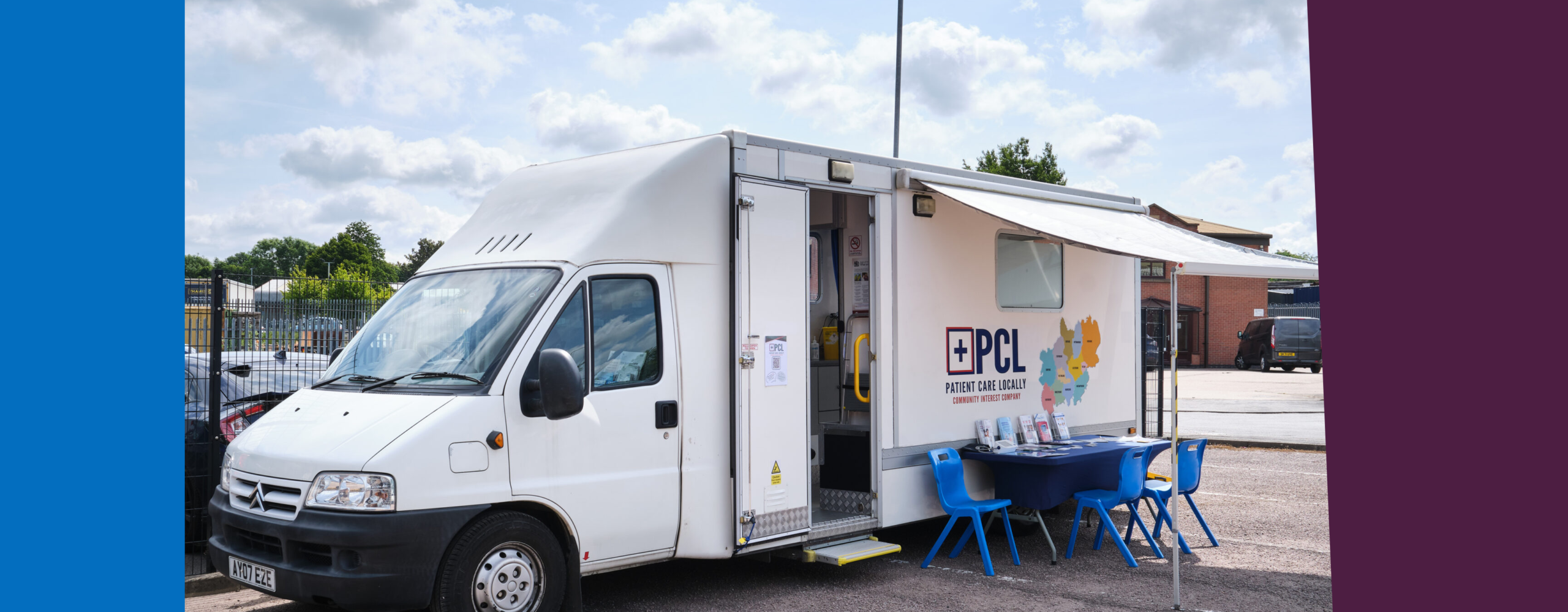
When Patient Care Locally (PCL) came to TASK, they had something genuinely valuable on their hands. A fleet of decommissioned ambulances, refurbished into fully functioning mobile health clinics, ready to take healthcare into the community. What they needed was someone to help people understand that.
The Roving Healthcare Units (RHUs) weren’t a gimmick. They were a serious response to a serious problem: the growing gap between healthcare provision and the people least able to access it. The homeless, the refugee population, those living with addiction as well as the elderly and those with a language barrier. People for whom a GP appointment can feel impossible, for reasons which are rarely simple.
TASK’s first job was to listen. To understand not just what the RHUs did, but what they meant. From there, a communications strategy took shape, one built around two distinct audiences. Service users, whose needs and circumstances shifted depending on the clinic being delivered. And service providers, NHS bodies and charities who might commission the RHUs as an alternative delivery model. Each audience needed it’s own voice, platform and message.
The campaign launched first through social media, expanding quickly to include short and long-form video that told the story of the RHU service. Printed collateral followed, placing the RHUs firmly in the public consciousness across Leicestershire and Rutland. Throughout, the tone remained consistent: warm, clear and trustworthy. With clinics ranging from smear tests and childhood immunisation to fibromyalgia scanning, COPD checks, mental health support – and everything in between. The messaging had to be fluid enough to serve very different audiences without ever losing coherence.
It worked. The NHS engaged at scale, as well as charity partners such as Turning Point, Heads Up and Inclusion Health. And the people the RHUs were designed to reach, many traditionally hardest to engage, showed up.
In 2024/25 alone, the RHU visited 115 locations and delivered over 32,500 vaccinations. More than 35,000 people received some form of care. The fleet grew to five vehicles and the service expanded into Nottingham, Northamptonshire, Warwickshire and Coventry.
That is, ultimately, what good communication does. It doesn’t just spread a message. It changes what’s possible.
Whether you’re engaging donors, supporting patients, informing the public, or inspiring travellers, we design every journey with your users in mind, ensuring intuitive, effective, and meaningful digital experiences.
If your website isn’t delivering the results you need, TASK can help you transform it into a powerful tool for growth, engagement, and impact.
